
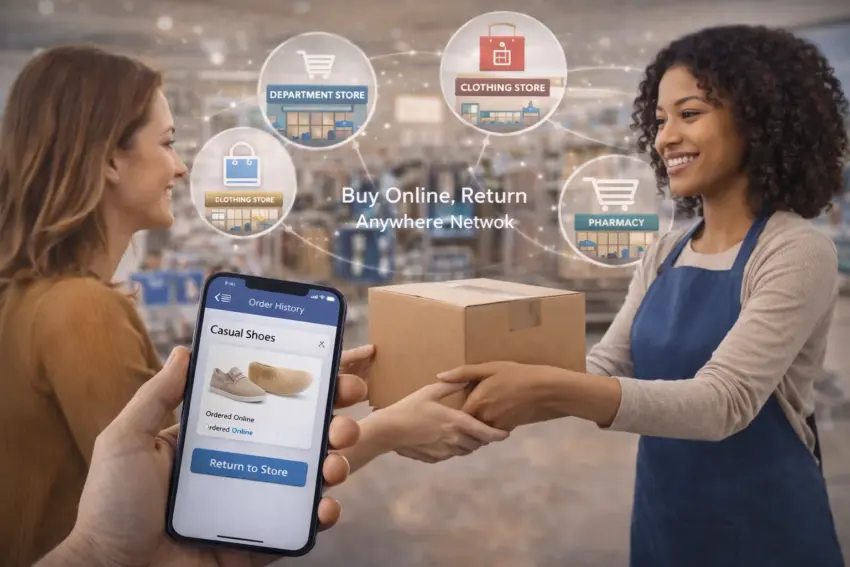
Retailers are rolling out “Buy Online, Return Anywhere” network partnerships, allowing shoppers to return online purchases at a wider range of drop-off locations beyond the original seller’s stores. The model is designed to reduce friction for customers, cut reverse-logistics costs, and speed up resale or restocking—while giving parcel shops, lockers, and partner chains a new stream of foot traffic.
What “Return Anywhere” partnerships are
In a traditional return, a customer either ships an item back or visits the retailer’s own store network. In a “return anywhere” model, retailers join a shared returns network that accepts parcels at multiple partner points—such as convenience stores, parcel carriers’ shops, automated lockers, or even other retailers—then consolidates shipments back to warehouses or processing hubs.
- Multi-brand drop-off points that accept returns for several participating retailers.
- Consolidated shipping where returns are batched to reduce transport costs.
- Label-free returns in some locations, using QR codes or digital receipts.
- Faster processing through centralized inspection and sorting hubs.
- Expanded hours via partner locations with longer opening times than retail stores.
Why retailers are investing in returns networks
Returns are a major cost center in e-commerce. Shipping, inspection, repackaging, fraud prevention, and markdown losses can quickly erase margins—especially in fashion and consumer electronics. By partnering on returns infrastructure, retailers aim to lower per-item handling costs and reduce the time products sit in limbo, which can be critical for seasonal inventory.
Retailers also want to improve the customer experience. When returns are easy, shoppers are more willing to buy online, try new sizes, and order higher-value items—often resulting in higher conversion rates. The challenge is offering convenience without letting return costs spiral.
What shoppers may notice
For consumers in Germany, “return anywhere” networks could mean fewer trips to post offices and more options near home or work. Many programs emphasize speed and simplicity: a QR code at a partner counter, an automated locker drop, or a scanned receipt that confirms the return instantly.
- More drop-off options including lockers, parcel shops, and partner stores.
- Less packaging if certain locations accept returns without a box.
- Instant confirmation when a return is scanned at drop-off.
- Faster refunds as processing becomes more standardized.
- Clearer return choices in checkout and account pages.
How it changes the economics of reverse logistics
Returns networks work best when they can consolidate volume. Instead of shipping one parcel at a time, partner locations collect returns and move them in batches to regional hubs. That can reduce transport emissions per item, lower carrier fees, and improve sorting efficiency. It also helps retailers route items to the best destination—restock, refurbishment, outlet resale, or recycling—rather than sending everything back to a single warehouse.
Risks: fraud, damage, and data sharing
Expanding return access also expands risk. Retailers worry about higher fraud attempts, swapped products, and “wardrobing” (using items and returning them). Networks need strong tracking, tamper checks, and consistent standards across partner locations. Another issue is data sharing: retailers must ensure customer information is handled properly when third parties process returns, especially under EU privacy rules.
- Chain-of-custody controls to track items from drop-off to processing.
- Standard inspection rules across partner points to reduce disputes.
- Privacy compliance for QR-based returns and shared logistics systems.
- Dispute resolution when items arrive damaged or incomplete.
What to watch next
As these partnerships expand, the competitive edge may shift from “free returns” toward “smart returns”: better routing, faster refunds, and incentives that reduce unnecessary shipping. Some retailers may steer customers toward exchanges or store credit to keep value in-house, while networks may add services such as on-the-spot quality checks or instant resale channels for returned goods.
Bottom line
“Buy Online, Return Anywhere” partnerships are an attempt to make returns more convenient while cutting the cost and complexity of reverse logistics. For shoppers, the biggest benefit is flexibility—more places to return items with less hassle. For retailers, the test will be whether shared networks can reduce costs without increasing fraud, delays, or customer disputes.