
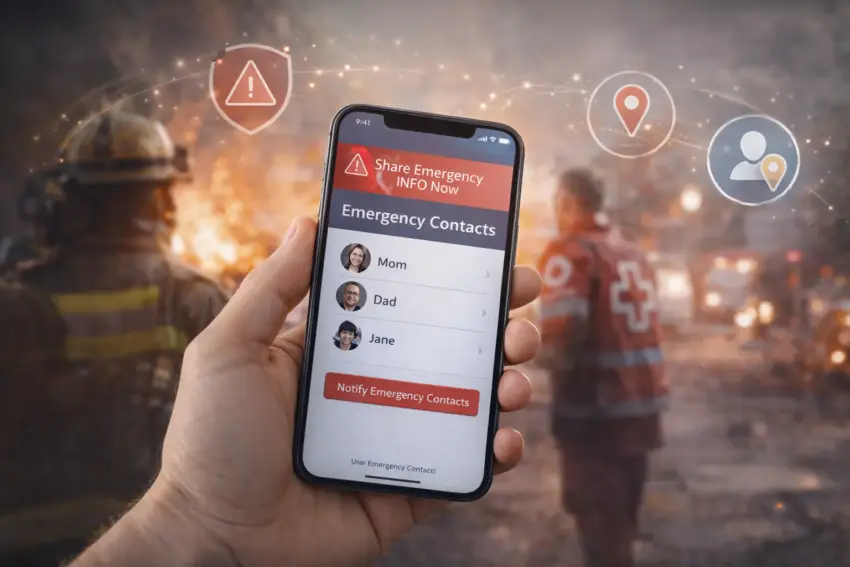
A new mobile operating system update adds an emergency contact sharing feature designed for use during disasters, allowing people to quickly broadcast their status and key contact details to trusted recipients when normal communication becomes unreliable. The update aims to reduce the chaos that follows storms, floods, wildfires, and major outages—when family members and colleagues often struggle to confirm whether someone is safe and where they can be reached.
How the emergency contact sharing feature works
The feature is built around a simple workflow: users preselect emergency contacts, then trigger a one-tap status share during an incident. Depending on connectivity, the phone can send the message over standard mobile networks, Wi-Fi, or alternative channels supported by the device. The shared information is typically limited to what is necessary for safety—such as a short status note and a temporary location snapshot—rather than continuous tracking.
- Preselected trusted contacts chosen in advance in system settings.
- Quick “I’m safe / I need help” status to reduce ambiguity in emergencies.
- Optional location snapshot to help responders or family find you.
- Time-limited sharing so information expires after the crisis window.
- Fallback delivery options when normal messaging is congested.
Why the update is being introduced now
Disasters increasingly disrupt communications at the worst possible moment. Even when networks remain online, congestion can delay calls and messages. Many people also move quickly between shelters, stations, and temporary accommodation, making it hard for relatives to know where they are. Operating system-level tools can help because they work across apps and can be designed to activate quickly under stress.
What users in Germany may notice
In Germany, the feature may be positioned as part of broader emergency readiness tools already present on smartphones, such as emergency call access, medical ID screens, and location-based alerts. Users will likely see a new settings section for emergency contacts and a guided setup flow that encourages people to add at least one trusted person and confirm what data will be shared.
- New setup prompts to add emergency contacts and review permissions.
- Lock-screen access to activate sharing quickly without navigating apps.
- Clear disclosure about what is shared (and what is not).
- Integration with existing emergency features like medical ID and SOS actions.
Privacy and control questions
Emergency features need to balance usefulness with privacy. Users generally want reassurance that the tool cannot be abused for stealth tracking and that contact sharing is always intentional. Most systems address this with explicit activation, time limits, and visible indicators. In the EU, transparency and data minimization are central expectations, so the most acceptable designs tend to share only what is necessary and only for as long as needed.
Limits: when it may not help
If a disaster causes total power loss and knocks out local towers and Wi-Fi, any phone-based sharing feature can fail. Battery life also becomes a constraint during multi-day events. The feature is best understood as a tool that improves odds when partial connectivity exists—rather than a guaranteed communication method in the most extreme scenarios.
- No signal zones: the feature cannot transmit without any network path.
- Battery pressure: users may need power-saving habits and backup charging.
- Overloaded networks: delivery can still be delayed during peak congestion.
- Contact readiness: the system works best if contacts are chosen and confirmed in advance.
How to prepare before an emergency
Because setup is easiest when there is no stress, users can improve readiness by configuring emergency contacts now, reviewing what information is shared, and ensuring the device is updated. It also helps to agree on a simple family plan: who checks messages, who relays information, and what statuses mean.
Bottom line
Emergency contact sharing built into a mobile OS can reduce uncertainty during disasters by letting people quickly confirm their status to trusted contacts. It will not replace resilient networks or emergency services, but it can make communication more reliable when systems are strained—especially when paired with good preparation, battery planning, and clear privacy controls.