
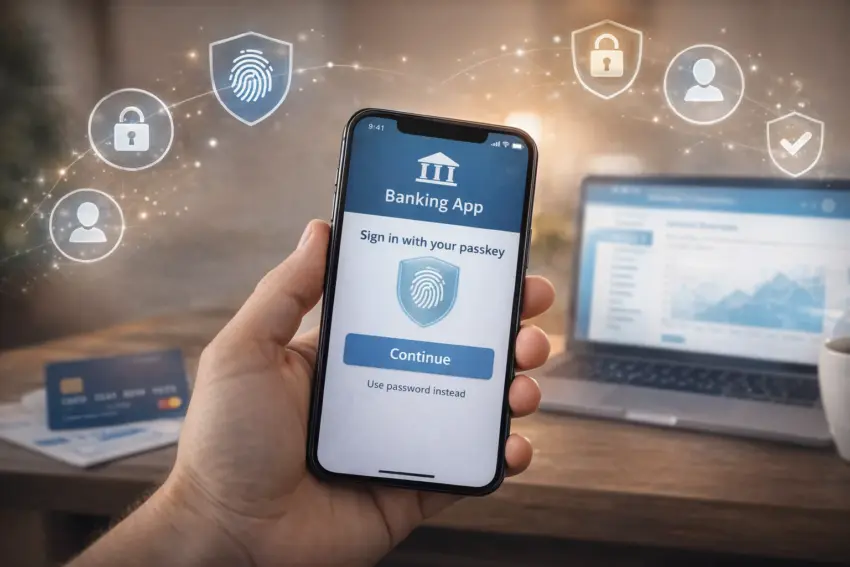
Banking apps are adding passkey login as passwordless adoption accelerates, marking a shift away from traditional passwords toward device-based authentication that is harder to phish and easier to use. The change is gaining momentum as banks look to reduce account takeover fraud, lower support costs tied to password resets, and meet customer expectations for faster, friction-light access on mobile.
What passkeys are
Passkeys replace passwords with cryptographic keys stored on a user’s device or in a secure cloud-synced keychain. Instead of typing a password, customers authenticate using a biometric method (such as fingerprint or face recognition) or a device PIN. The bank verifies the login using a cryptographic challenge, which reduces the value of stolen credentials and makes phishing attacks far less effective.
- Phishing resistance: passkeys are tied to the correct website/app and cannot be “typed into” fake login pages.
- Device-based security: the private key stays on the device, not on the bank’s server.
- Faster login: biometric or PIN confirmation replaces password entry.
- Fewer resets: reduces customer support and lockout incidents.
- Compatible with modern standards: built on FIDO-based authentication flows.
Why banks are moving now
Banks have been prime targets for credential theft, phishing campaigns, and “SIM swap” attacks aimed at intercepting one-time codes. Passkeys address several of these risks at once, especially when paired with strong device security. They also fit the reality of mobile banking: most customers already unlock their phones with biometrics, so the login step becomes a natural extension of an existing habit.
Another driver is customer experience. Banks compete not only on products, but on daily usability—how quickly users can check balances, approve transfers, and confirm card payments. Passkeys can reduce friction without weakening security.
How passkey rollout typically works in banking apps
Most institutions introduce passkeys as an option alongside existing login methods, then gradually expand eligibility. Early rollouts often focus on mobile apps first, where secure enclaves and biometric prompts are widely available.
- Opt-in setup inside the app after a conventional login.
- Device verification using biometrics or a PIN to create the passkey.
- Fallback methods kept in place (for example, app-based approval, SMS, or recovery codes).
- Step-up security for high-risk actions such as adding payees or changing contact details.
- Multi-device support via secure synchronization where supported by the user’s ecosystem.
What users in Germany should expect
For customers in Germany, passkey login will likely appear as a new sign-in option after updating the banking app. Many banks will still require extra confirmation for sensitive actions (for example, large transfers), but everyday access—opening the app, viewing balances, and basic management—could become faster and more consistent.
Users will also see more guidance around device security, because passkeys rely on the protection of the phone or computer. If a device is compromised or unlocked by another person, access risks increase—making strong device PINs and secure biometric enrollment important.
Limits and open questions
Passkeys reduce phishing risk, but they do not eliminate fraud entirely. Social engineering can still persuade users to approve actions, and malware on a device can still pose threats. Banks also need reliable account recovery processes: if users lose access to their devices, they must be able to regain entry without creating new security gaps.
- Account recovery: the hardest part of passwordless systems if a device is lost.
- Shared devices: less suitable when multiple people use one phone or tablet.
- Enterprise environments: some workplaces restrict biometric or keychain syncing features.
- User education: customers need clarity on how passkeys work and how to avoid scams.
Bottom line
The adoption of passkeys in banking apps signals a broader security transition: moving away from passwords that can be stolen and reused toward device-bound authentication that is harder to attack at scale. For users, the biggest benefit is simpler login with stronger protection. For banks, the challenge will be rolling out passkeys without breaking access for customers who rely on older devices or need robust recovery options.