
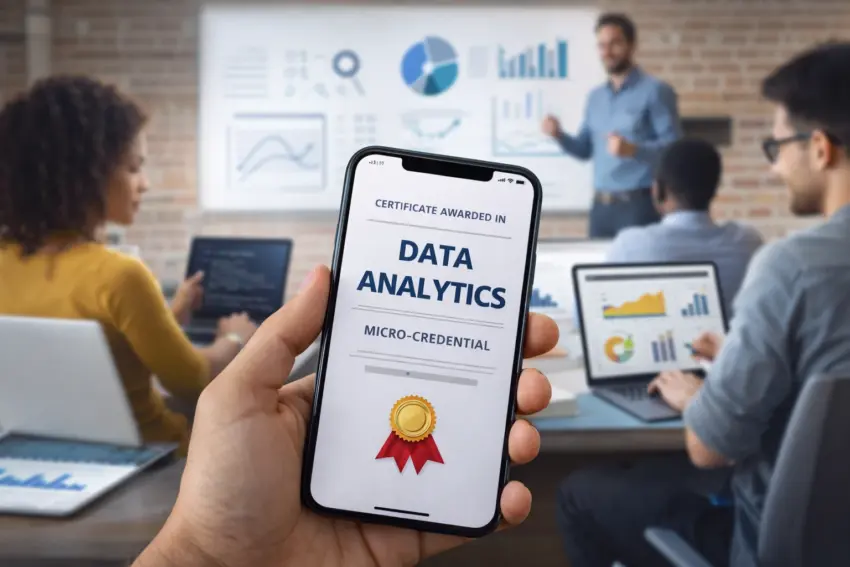
Universities are expanding micro-credential programs for data skills as demand grows for short, job-focused training that sits between a full degree and informal online courses. The expansion reflects changing employer expectations: many roles now require practical competence in analytics, automation, and data literacy—even outside traditional “tech” departments.
What micro-credentials are
Micro-credentials are compact learning units—often delivered online or in blended formats—that certify specific skills. They typically involve structured coursework, assessed projects, and a formal certificate issued by a university or accredited partner. Unlike short workshops, they are designed to be stackable: learners can combine multiple credentials into larger qualifications over time.
- Short duration: commonly a few weeks to a few months.
- Skill-specific: focused on clearly defined outcomes (for example, SQL basics or dashboard building).
- Assessments included: projects, tests, or applied tasks to verify competence.
- Stackable paths: multiple badges can count toward a certificate or degree in some models.
- Industry alignment: curricula often shaped with employer input or sector standards.
Why data skills are a priority
Data skills are increasingly seen as foundational, similar to office software proficiency in earlier decades. Organizations want staff who can interpret metrics, automate routine reporting, and work confidently with data governance requirements. Universities are responding by packaging these competencies into targeted micro-credentials that are easier to start—and finish—than a multi-year program.
Which skills are most commonly offered
Programs vary by institution, but offerings are converging around a set of practical, workplace-relevant topics. Many universities also differentiate between “data literacy” tracks for non-technical roles and deeper analytics tracks for specialist pathways.
- Data literacy: interpreting KPIs, basic statistics, and data-driven decision-making.
- Spreadsheets to analytics: advanced Excel/Sheets, modeling, and reproducible reporting.
- SQL and databases: querying, joins, data cleaning, and performance basics.
- Python or R fundamentals: analysis workflows, notebooks, and automation.
- Visualization: dashboards, storytelling with data, and usability principles.
- AI and machine learning basics: model concepts, evaluation, and responsible use.
- Data governance: privacy, compliance, documentation, and quality assurance.
What this means for learners in Germany
For learners in Germany, micro-credentials can appeal to working professionals who need upskilling without stepping away from full-time employment. They are also increasingly marketed to students as an employability add-on—helping graduates signal readiness for roles in business analytics, marketing, operations, HR, and public administration.
Another driver is transparency. A well-defined micro-credential can communicate a clearer skill profile than broad course titles, especially when certificates include learning outcomes and assessment criteria.
How employers are using micro-credentials
Employers often treat micro-credentials as evidence of practical capability—particularly when paired with a portfolio project. Some companies use them for internal development, sponsorship programs, or as part of structured talent pipelines. However, recognition still varies widely across sectors and hiring teams.
- Hiring signals: proof of specific tools and methods used in real tasks.
- Upskilling plans: structured training for teams adopting analytics platforms.
- Role transitions: pathways for employees moving into analyst or reporting roles.
- Compliance needs: training tied to data protection and governance expectations.
Challenges: quality, consistency, and overload
The expansion also raises questions. With many providers offering badges and certificates, universities are under pressure to show that micro-credentials maintain academic standards and real assessment. There is also a risk of credential overload—where learners collect many small certificates without building coherent, job-ready capability.
- Standardization: inconsistent formats can make certificates hard to compare.
- Assessment quality: employers value projects more than attendance-based badges.
- Stackability clarity: unclear rules on whether credits count toward degrees.
- Equity: fees and time constraints can limit access for some learners.
What to watch next
As micro-credentials scale, the key developments will be stronger frameworks for recognition, clearer credit-transfer pathways, and more visible evidence of outcomes—such as capstone projects mapped to real job tasks. Universities are also expected to expand partnerships with employers and public institutions to ensure that micro-credentials align with hiring needs and workforce priorities.
Bottom line
Micro-credential expansion in data skills signals a shift in higher education toward modular, employment-oriented learning. For universities, the opportunity is to deliver trusted, assessable training at speed. For learners, the value depends on quality and coherence: the best programs combine practical projects, clear outcomes, and a pathway that builds toward real capability—not just a digital badge.