
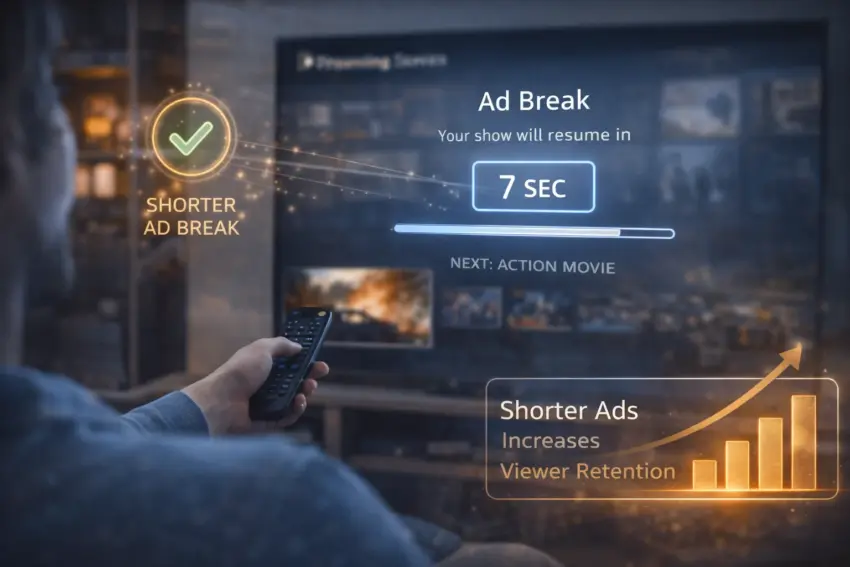
Streaming platforms are testing shorter ad pods in an effort to reduce viewer drop-off and keep audiences engaged through ad-supported tiers. The experiments reflect a growing concern among services that traditional TV-style ad breaks—especially when clustered—can trigger immediate abandonment, app switching, or session endings, undermining both ad revenue and subscriber retention.
What “shorter ad pods” look like
An ad pod is a group of ads played back-to-back. In streaming, these pods can appear before content (pre-roll), during playback (mid-roll), or at natural breaks between episodes. The new tests focus on reducing the number of ads per break, trimming total seconds, and changing how often breaks appear.
- Fewer ads per break (for example, 1–2 ads instead of 4–6).
- Shorter total runtime (cutting pods from ~60–90 seconds down to ~15–45 seconds).
- More predictable placement aligned with scene changes or episode transitions.
- Lower frequency by spacing breaks farther apart, especially early in an episode.
- “Single sponsor” pods where one brand buys an entire short break to reduce clutter.
Why viewer drop-off matters more in streaming than TV
Streaming services have an immediate feedback loop: if viewers leave during ads, platforms see it instantly—down to the second. Unlike linear TV, where switching channels still keeps the viewer within an ad-supported ecosystem, streaming drop-off often means a user closes the app entirely or returns to a different service. That reduces ad impressions, weakens targeting and measurement, and can increase churn risk if audiences feel the experience is worse than expected.
For ad-supported tiers that are priced to attract cost-sensitive viewers, the user experience is especially fragile. A few poorly timed or overly long breaks can make the tier feel like “paid TV with too many ads,” pushing users either back to premium plans or out of the service.
The economics: fewer ads can still mean more revenue
At first glance, shorter pods look like fewer opportunities to sell inventory. But platforms argue that improving completion rates and session length can raise the total number of ads delivered per viewing session—because people stop quitting mid-episode. If viewers stay longer, the service can deliver more impressions over time, often at higher quality (viewed to completion, with sound on, on the biggest screen).
- Higher completion rates can increase advertiser confidence and pricing.
- Longer sessions can deliver more total impressions, even with fewer per break.
- Better brand lift may come from less clutter and improved attention.
- Lower annoyance can reduce cancellations and tier switching.
What viewers may notice
If the tests expand, users in Germany and across Europe may notice shorter interruptions that feel more “digital” than “broadcast.” Breaks may arrive more consistently at natural pauses, and some services could replace longer mid-roll breaks with shorter “chapter-style” interruptions.
- Shorter breaks that end before viewers reach for the remote.
- Less repetition as platforms try to avoid showing the same ad multiple times per episode.
- More sponsorship formats such as “presented by” bumpers instead of full pods.
- More relevant ads if services trade quantity for better targeting and pacing.
Advertisers are pushing for quality over volume
Brands increasingly want proof that ads are actually watched, not skipped or abandoned. Shorter pods can help by reducing clutter and improving attention. For advertisers, it can also simplify measurement: a fully viewed 20-second spot in a calm break may be more valuable than a 90-second block that viewers escape halfway through.
This shift also supports premium pricing for “lighter ad load” placements—inventory that promises fewer interruptions and better viewing conditions. Services may package these placements as premium deals rather than treating them as standard ad slots.
The trade-offs and open questions
Shorter pods are not a universal fix. If platforms compensate by increasing the number of breaks, users may still feel interrupted. And if ad loads become too light, smaller services may struggle to fund content without raising prices. The effectiveness also depends on ad diversity: even a short pod becomes irritating if it repeats the same message too often.
- Frequency vs. length: fewer long breaks can feel better than many short ones.
- Repetition control: limiting the same ad helps reduce fatigue.
- Placement integrity: poorly timed breaks can still trigger exits.
- Content type: live sports, films, and kids content behave differently than series.
Bottom line
Streaming services testing shorter ad pods are trying to solve a simple problem: long ad breaks make it easier for viewers to leave. By reducing pod length and improving pacing, platforms hope to keep sessions intact, raise ad quality, and make ad-supported tiers feel less like traditional TV. Whether the approach succeeds will depend on execution—especially how often breaks appear, how repetitive ads are, and how well interruptions match the flow of the content.