
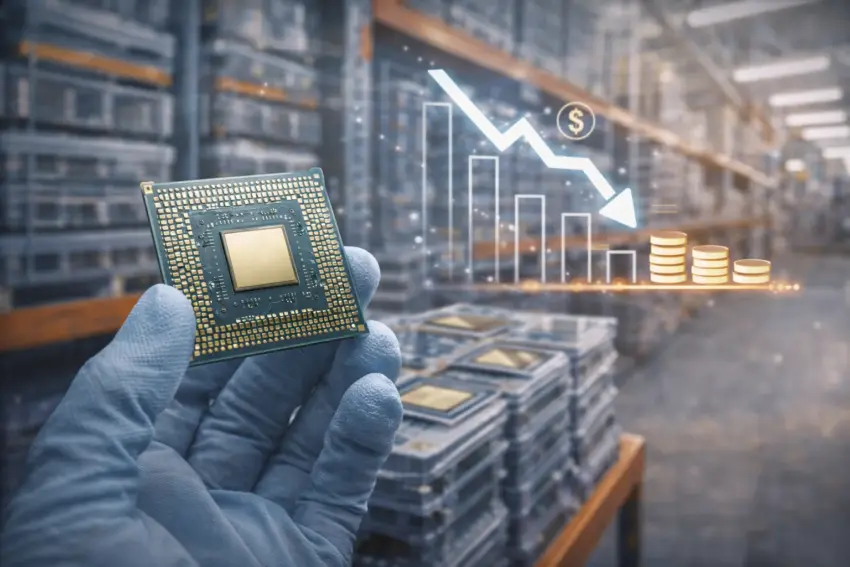
Several of the world’s largest semiconductor manufacturers and component suppliers are signaling that chip prices are easing as inventories move closer to normal levels. After a period marked by shortages, rapid price increases, and extended delivery times, the market is showing clearer signs of balance—particularly in segments linked to consumer electronics and parts of industrial demand.
What “softer prices” means in the chip industry
In semiconductors, pricing often follows inventory and lead times. When supply is tight, buyers pay premiums and accept long waits. When warehouses refill and order backlogs shrink, suppliers tend to offer discounts, reduce surcharges, or compete more aggressively on contract terms. “Softer prices” usually appears first in widely used components—such as standard memory, display-related chips, and certain microcontrollers—before reaching more specialized parts.
- Shorter lead times for commonly used parts and fewer allocation limits.
- Discounting in spot markets and more flexible long-term pricing.
- Higher customer bargaining power as urgent replenishment slows.
- More cautious ordering from device makers avoiding overstock.
Why inventories are normalizing now
Inventory normalization is typically driven by two forces: improved supply and more measured demand. Capacity additions made during the shortage era are now feeding into the market, while many customers have shifted from “order ahead” behavior to tighter purchasing. In practical terms, companies are trying to avoid being stuck with excess chips that can lose value quickly as product cycles change.
Another factor is the gradual cleanup of “double ordering”—a pattern where buyers placed orders with multiple suppliers to secure any available supply. As supply becomes more predictable, that behavior fades, and order books look less inflated.
Not all chips are moving the same way
The semiconductor market is not one single market. Price pressure can appear in one category while another stays tight. Many suppliers are currently describing a split landscape: softer conditions in some consumer-linked components, steadier demand in automotive and industrial, and continued strength in parts tied to high-performance computing and data centers.
- Memory and commodity components: often the first to show price declines when supply loosens.
- Automotive-grade chips: typically more stable due to qualification cycles and long-term supply contracts.
- AI and data center hardware: demand can remain strong even when other segments cool.
- Power management and analog: performance varies widely by end market and supplier mix.
What this could mean for device prices
Cheaper chips do not automatically translate into cheaper phones, laptops, cars, or appliances. Manufacturers may use cost relief to protect margins, fund new product development, or offset other costs such as logistics, energy, and labor. Still, easing component prices can reduce pressure on pricing and may support more promotional activity in electronics—especially if retailers are also working through their own inventory.
Signals companies and buyers are watching
Investors and procurement teams typically track a similar set of indicators to judge whether softer pricing is a short-lived adjustment or a longer cycle shift.
- Inventory days reported by chipmakers and distributors.
- Lead-time trends for high-volume parts across regions.
- Order cancellations and “push-outs” (delayed deliveries) in quarterly results.
- Capacity utilization at major foundries and packaging providers.
- End-market demand signals from PC, smartphone, and industrial customers.
Bottom line
As inventories normalize, chipmakers are increasingly acknowledging softer pricing conditions in parts of the market. The shift suggests a move away from scarcity-driven dynamics toward more typical competition—though the picture remains uneven across product categories. For businesses and consumers, the main impact may be better availability, more flexible supply contracts, and—where competition is strongest—selective cost relief in electronics supply chains.